"It's a world of laughter, a world of tears. It's a world of hopes, and a world of fears. There's so much that we share, that it's time we're aware. It's a small world after all." - written by Richard M. Sherman and Robert B. Sherman & made famous by Walt Disney

Monday, August 14, 2017

Chinese on the Western Front in WWI


Historians of the World Wars recognize the importance of the Asian nations, but not as participants in Europe.  In particular Europe during WWI is defined by trench warfare.  However, unknown to many the Chinese Labour Corps provided the manpower to dig the actual trenches for the allied side.  Even though China began the war neutral by 1917 they declared war on Germany (exactly 100 years ago) and solidified their alliance with Britain and France.
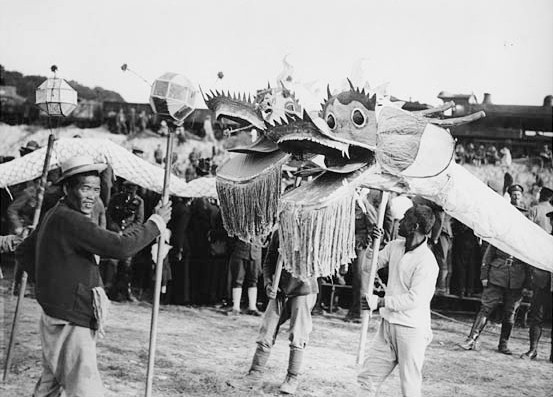
Chinese entertain British troops in France. Dragons ready for the Dragon fight. Photo: National Library of Scotland

The University of Oxford created a website called World War I Centenary with the focus on new directions in teaching the Great War.  The article Eastern Culture on the Western Front written by Dr. Matthew Leonard goes in depth on the role of the Chinese Labour Corps.

China's WWI is an amazing resource by The South China Morning Post.  Photos, artifacts, and news articles are included that give a global view of the Great War that the western world often ignores when writing history.


Smiling for the Camera - WJ Hawkings Collection, courtsey of John de Lucy

Monday, June 5, 2017

A Timeless Description

A Timeless Description: I feel robbed that I did not get the opportunity to ask my Great Uncle Burl what it was like to train in North Africa or share stories of being at the Duomo in Florence. I was a young teen when he passed, and he did not share the horrors he saw as part of the 316th Medical Battalion in the liberation of Italy. I post this on the 73rd Anniversary of the American liberation of Rome.

Then as an adult, I received the precious gift of his scrapbooks, which have given me a little insight. One particular annotation on the back of a photo caught my eye. Among images of young men in uniform going from the desert to mountains and snow, there was one of a destroyed building. On the back Uncle Burl wrote, “This was someone’s home at one time, I hope this never happens in the states.” I feel this description is timeless. No matter what is going on in the world humans make decisions on whether to take action or not, but we always hope the bad does not find its way to our homes and family. Burl was lucky and made it back to marry his love Phyllis, and be a second grandfather to me. 

Wednesday, March 8, 2017

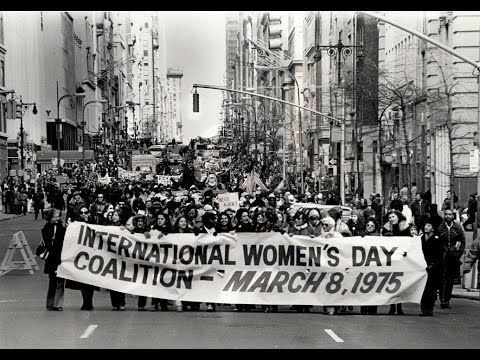
International Women's Day

After the Women's Marches of the Winter of 2017, International Women's Day of March 8 with the theme Be Bold For Change seemed very appropriate.  Women around the world joined together in a united voice to advocate for change for half the world's population.  In the United States this year a movement to not work on March 8 and wear red was spearheaded as a Day Without Women to protest political and economic inequality.  These protests spread throughout the world with demonstrations on almost every continent. 

A demonstration in Seoul, South Korea, against gender inequality in the workplace. Credit Jean Chung/Getty Images

The fascinating element of early 2017 and united protests is that they replicate the original inspirational events that led to International Women's Day in the first place.  According to the United Nation's page on the History of the Day, 1909 saw the first National Women's Day in the U.S. organized by the Socialist Party of America as a garment worker's strike.  Then in 1911 Austria, Denmark, Germany, Switzerland organized more than a million to demand women's right to work and a political voice behind the leadership of Socialist International.  March 8 first took significance as part of the socialist revolution in Russian in 1917 when on this day women protested for bread and peace, which led to the fall of the Tsarists regime.  Then in 1975 the United Nation's officially recognized International Women's Day and set it for March 8th.

Image result for international women's day history

Tuesday, June 14, 2016

Flag Day and an African Nation

2016 students painting flags in my classroom.
 The birth of Old Glory is attributed to June 14, 1777 still during the early years of the Revolutionary War by the Continental Congress.  Less than a year after the Declaration of Independence the US need a symbol to separate itself from Great Britain and gain further recognition as a new country.  However, Flag Day was not made official until President Truman's proclamation in 1949.   The United States is not unique in the celebration of their nation's flag.  Over 50 other countries around the world commemorate a variety of historical events through their flags.  

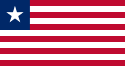
Including Liberia, originally an American colony in Africa that declared independence from the US in 1847.   The first President of Liberia was Joseph Jenkins Roberts a free born African American from Virginia.  August 24th is celebrated as Flag Day and the influence of the United States is very evident in the red, white, and blue design.


Flag of Liberia
Liberian Flag established by the United States

Source:  American Memory - Library of Congress
http://memory.loc.gov/ammem/today/jun14.html

Monday, June 15, 2015

One Document to Rule them All

Today June 15, 2015 is the 800th Anniversary of the Magna Carta being sealed by King John.  This document signified the beginning of a population questioning the authority of an anointed monarch.  560 years later British subjects in the American colonies would reference the document in their rebellion to overthrow the rule of a monarch.  Later the 5th amendment to the constitution sounds much
Like these words from the Magna Carta:

"No freeman shall be taken, imprisoned, disseised, outlawed, banished, or in any way destroyed, nor will We proceed against or prosecute him, except by the lawful judgment of his peers or by the law of the land."

"To no one will We sell, to no one will We deny or delay, right or justice."


Read more from the birthday article by NPR below that even feature a Google doodle.


http://www.npr.org/sections/thetwo-way/2015/06/15/414616460/magna-carta-is-800-this-awful-thing-that-shaped-legal-rights


Tuesday, November 11, 2014

Happy Birthday Gen. Patton!

One of the most well know and controversial American Generals of all time is Gen. George Patton.  I find it very appropriate that Veteran's Day is also his birthday.  He was your quintessential soldier's soldier, and is even buried among his men that died fighting at the Battle of the Bulge in Luxembourg.  From chasing Pancho Villa to fighting under Blackjack Pershing in WWI to pushing for the creation of the first US tank force to his most famous successful leadership in WWII Patton was a soldier from birth and never was bashful in proclaiming his desire to be a 20th century American hero.   His prayer below is very appropriate to take in as we remember our Veteran's.

"God of our fathers, who by land and sea have ever led us to victory, please continue your inspiring guidance in this the greatest of all conflicts. Strengthen my soul so that the weakening instinct of self-preservation, which besets all of us in battle, shall not blind me of my duty to my own manhood, to the glory of my calling, and to my responsibility to my fellow soldiers. Grant to our armed forces that disciplined valor and mutual confidence which insures success in war. Let me not mourn for the men who have died fighting, but rather let me be glad that such heroes have lived. If it be my lot to die, let me do so with courage and honor in a manner which will bring the greatest harm to the enemy, and please, oh Lord, protect and guide those I shall leave behind. Give us the victory, Lord."

General George Patton


Sunday, November 9, 2014

How Springsteen "Cracked" the Berlin Wall

Again NPR revealed another unknown to me story that shows how small the world really is.  With the 25th anniversary of the fall of the Berlin Wall stories of life in East Germany and of this turning point in history have flooded the news, but the one that stuck out the most to me was the role the musician best known for his song "Born in the USA" had in the decline of communist Europe.   In July 1988 the GDP gave its youth wing permission to host a concert with a western singer to ease tensions.  It completely backfired.  "It was gradually dawning on everyone between about 20 and 30 years old that things couldn't just continue in East Germany the way they had been going. Something had to change. And when Springsteen came, his concert fitted right into all that."  Said Berliner Andrea Dubois (the guardian.com)

Just over a year later the wall fell.  Yes Reagan demanded, "Tear down this wall."  However, to 160,000 Springsteen said, “It’s great to be in East Berlin,” he said. “I’m not for or against any government. I came here to play rock & roll for you, in the hope that one day all barriers will be torn down.”

Friday, October 31, 2014

Halloween from the Celts

History of Halloween courtesy of the History Channel

I always play this video clip and show the article about the history of Halloween in my classes.  It does a great job showing the progression from the Celtic holiday Samhain to our modern concept of Halloween.
My Son Ethan the Pirate

Wednesday, October 15, 2014

Italian Architecture in Virginia

Besides the V and cross swords, the most well-known symbol of the University of Virginia is the Rotunda.  Anyone connected to the university or Charlottesville knows that this is the school Jefferson built.  He designed the buildings, gardens, and the academic curriculum.  However he did not create them brand new.  He used his studies and travels from Europe as inspiration.  I had the amazing pleasure to recently travel to Rome and got to experience Jefferson's inspirations first hand.  As a UVa grad the most powerful moment of my trip was standing in the Pantheon, which is the model for the Rotunda (finished in 1826 and added to the National Registrar for Historic Places on Oct. 15, 1966).  With its amazing dome and columns this 2000 year old building overwhelmed me.  This will be the first in a few blog posts about Italian culture influence on the third American President.
Pantheon
 Rotunda

inside the Pantheon

Wednesday, August 13, 2014

An Unknown Declaration of Rights

“Declaration of the Rights of the Negro Peoples of the World”: The Principles of the Universal Negro Improvement Association

After international contributions that African Americans made in the First World War soldiers who had fought for both the French and the United States returned home and demanded the same rights for those of African heritage around the world.  Led by Marcus Garvey the UNIA combined elements of Wilson's 14 points and the Bill of Rights to show unity in the need for worldwide equality. 

This thought provoking document was the attempt of African Americans to take their movement to the world as they still faced extreme discrimination at home.  They hoped for international support at a time when the United States had risen to the pinnacle of power as victors of World War I.  The document lists both American atrocities of inequality and discrimination and also the actions of Europeans to dominate the African continent.  It would not be until after the next world war when Jim Crow and imperialism begins to fall does the goals of the UNIA begin to be realized.

Here is the document in its entirety:  http://historymatters.gmu.edu/d/5122/


Saturday, June 28, 2014

Declaration of Rights Around the World


On June 28th, 1776 Thomas Jefferson presented his Declaration of Independence to the Continental Congress after weeks of writing and revisions and editing by the five member committee that included Benjamin Franklin, John Adams, Roger Sherman, and Robert Livingston.  It was not the first or the last time leaders felt the need to put pen to paper and establish the need to declare the rights of mankind.


1690 - John Locke's Second Treatise on Government:
“The state of nature has a law of nature to govern it, which obliges every one; and reason, which is that law, teaches all mankind who will but consult it, that, being all equal and independent, no one ought to harm another in his life, health, liberty, or possessions."

June 1776 - George Mason's Virginia Declaration of Rights
THAT all men are by nature equally free and independent, and have certain inherent rights, of which, when they enter into a state of society, they cannot, by any compact, deprive or divest their posterity; namely, the enjoyment of life and liberty, with the means of acquiring and possessing property, and pursuing and obtaining happiness and safety. 

July 1776 - Thomas Jefferson's Declaration of Independence:
 We hold these truths to be self-evident, that all men are created equal, that they are endowed by their Creator with certain unalienable Rights, that among these are Life, Liberty and the pursuit of Happiness.

1793 - Article 2 of the French Declaration of the Rights of Man and Citizen:
The aim of all political association is the preservation of the natural and imprescriptible rights of man. These rights are liberty, property, security, and resistance to oppression.

1876 - Declaration of the Rights of Women (National Women Suffrage Association)
We ask of our rulers, at this hour, no special favors, no special privileges, no special legislation. We ask justice, we ask equality, we ask that all the civil and political rights that belong to citizens of the United States, be guaranteed to us and our daughters forever.

1948 - Articles 1 & 3 of the UN's Universal Declaration of Human Rights:
All human beings are born free and equal in dignity and rights.They are endowed with reason and conscience and should act towards one another in a spirit of brotherhood.
Everyone has the right to life, liberty and security of person.

Saturday, June 14, 2014

Wilson's Proclamation 1335 - Flag Day


"Let us on that day rededicate ourselves to the nation, "one and inseparable" from which every thought that is not worthy of our fathers' first vows in independence, liberty, and right shall be excluded and in which we shall stand with united hearts, for an America which no man can corrupt, no influence draw away from its ideals, no force divide against itself,-a nation signally distinguished among all the nations of mankind for its clear, individual conception alike of its duties and its privileges, its obligations and its rights."
 
Woodrow Wilson could not have picked a better time to try and unify the country through the symbol of the American flag.  On May 30th, 1916 he gave his Presidential Proclamation 1335, which established Flag day.  He had many motives for doing so.  The United States had become a nation of immigrants in the second half of the 19th and early 20th century, there were still deep cultural divides between North, South, and West, and the country was again being pulled apart by the European conflict later known as WWI.  Wilson won the presidency on a pacifist platform and continued to keep the US out of the international war.  However, the Lusitania had been sunk and continuing German u-boat threats to the seas prompted many Americans to advocate the country joining the war.  Flag day has lasted but Wilson's pacifism did not and reluctantly followed with Congress's declaration of war less than a year later.


"Many circumstances have recently conspired to turn our thoughts to a critical examination of the conditions of our national life, of the influences which have seemed to threaten to divide us in interest and sympathy, of forces within and forces without that seemed likely to draw us away from the happy traditions of united purpose and action of which we have been so proud."

Woodrow Wilson's Complete Speech from the American Presidency Project
http://www.presidency.ucsb.edu/ws/?pid=62991

Monday, May 26, 2014

Springtime Memorial Celebrations

Springtime usually means the onset of flowers and a renewal of life, but it has also been a time to mourn and memorialize  sacrifices made by those in the armed services.  Memorial Day on the last Monday of May each year is a time to remember and honor those who gave their lives for America. After the Civil War, local communities through both the north and south began the practice of systematically placing flowers on the graves of those who served.  It did not become an official national holiday until1971.
Source:  US Dept. of Veteran's Affairs

Other nations followed the example set by the Americans and after the World Wars nations throughout the world established their own Memorial Days.

  • Dodenherdenking (Remembrance of the Dead) - May 4th Netherlands (est. 1961)
  • Vimy Ridge Day - April 9th Canada (est. 2003)
  • Anzac Day - April 25th Australia (est. 1920)

Sunday, April 13, 2014

Jefferson and Macaroni

Thomas Jefferson is one of the most complex and controversial figures in American History.  His birthday of April 13th (also my grandmother's) always makes me want to discover something new about this fascinating man.  It is not just my University of Virginia brainwashing, but the fact that Jefferson is truly America's Renaissance man.  Jefferson made it a point to be a cultural connection between America and the world especially when it came to food.  In 1793 a macaroni mold from Naples made its was to Monticello.  He probably was not the first to introduce the food to America but he did popularize it with his dinner parties at both Monticello and the White House.  Guests would then return home and want the same food as that of the writer of the Declaration of Independence.

http://www.loc.gov/exhibits/treasures/images/tlc0465.jpg
http://www.monticello.org/site/research-and-collections/macaroni 

Sunday, March 23, 2014

Liberty or Death: An International Slogan

Patrick Henry's Mar. 23rd, 1775 speech is a right of passage for many Virginia students.  I have the vivid memory of learning the speech in the fourth grade.

"Is life so dear, or peace so sweet, as to be purchased at the price of chains and slavery? Forbid it, Almighty God! I know not what course others may take; but as for me, give me liberty or give me death!"

The words not only inspired Virginians to join the American War for Independence, the same language would be used worldwide as the independence movements spread. Here are just some examples:

Eleftheria i thanatos (Freedom or Death) became the motto of Greece during their war for Independence from the Ottomans in the 1820s. 

Independência ou Morte! (Independence or Death) - Official Brazilian independence from Portugal in 1825

Patria o muerte (Homeland or Death) - 1898 Cuban Independence from Spain (after Spanish American War)

Sloboda ili smrt (Liberty or Death) - Macedonian independence from Yugoslavia in 1991

Libertad o Muerte (Liberty or Death) - In 1828, Uruguay won its independence from Spain.

Friday, March 14, 2014

Pesto chips

Students are always fascinated when going abroad with American food that has been "tweaked" in foreign countries.  One of our favorite games is spot the most unique chip or crisp to many nations (chips are french fries).  Some of the front runners include pesto and bratwurst.   The lesson that we learn is that it is not just Americans stealing ideas and making them our own, but everyone around the world wants a part of pop culture but need to make it fit their own tastes.  Click here for a great blog/website article that lists chip flavors by country in honor of National Potato Chip day on Mar. 14th.

Tuesday, December 10, 2013

It is hard to change cultures

Stubbornness is definitely a trait that the Bits passed on to the Yanks especially when it comes to measurements.  I was not aware until not too long ago that there was an organized educational push in the 70s and 80s to get the United States on the metric system.   By the way the metric system was officially adopted in France on Dec. 10, 1799 just as the revolution was coming to an end.

Well, I have no idea how many liters of gas my car will hold so this concept has not taken hold here.  I do not know why except to blame stubbornness and laziness, but the same can be said of the British with driving on the left and using the pound.  Now I do not blame them for keeping the pound instead of switching to the Euro (not a good idea to link your economy so directly with Southern Europe) but driving in the British Commonwealth is unbelievable.  One of the first directions we give students when traveling to England is look right when crossing the street.  It is also mind boggling that distance on road signs are in kilometers but the speed is in miles per hour.  At least I can drive a stick shift.

Sunday, December 8, 2013

Strong Leaders Accept Fear

On this the 72nd anniversary of Franklin D. Roosevelt's Date Which Will Live in Infamy speech, I cannot help but try to connect him to the great leader of Nelson Mandela whose life the world is currently celebrating.  A common thread that I have seen on television and the internet is the public asking politicians and all leaders to learn from the life Mandela.  In my opinion, it has not been since FDR have we had a President so deeply appreciated as to make any connection to the role made by Mandela in South Africa.   Roosevelt grew up a wealthy white American while Mandela an oppressed villager, but through education both rose to completely change the path of their nation.  Both faced obstacles whether it was the confinement to a wheel chair or an actual prison, but both accepted fear and used it to inspire others. 

"The only thing we have to fear is fear itself." - Franklin Roosevelt

“I learned that courage was not the absence of fear, but the triumph over it. The brave man is not he who does not feel afraid, but he who conquers that fear.” - Nelson Mandela


Click Here to listen to the Dec. 8th, 1941 speech (courtesy of the National Archives) made via the radio by Roosevelt after the attack on Pearl Harbor.  Three and half hours later he would sign the declaration of war.

Monday, November 11, 2013

Remembrance Poppy for Veteran's Day

One of the most beautiful sites in all of Europe are the poppy field overlooking the Normandy Beaches in Northern France.  It was unbelievable to see the German bunkers jutting out of the sea of yellow and red.  The poppy is a global symbol applied to honoring the service of soldier's to their nation.  The poem below titled In Flanders Fields was written by Canadian physician, John McCrae at the time of the battle of Ypres during the First World War.  It inspired the American Legion to use the flower to honor the sacrifices of soldiers.  The American Legion Poppy program is still going strong today.  In Great Britain, Poppy Day, also known as Remembrance Day is recognized on the second Sunday in November to commemorate service men and women killed in action since 1914. Thank you to those who serve!

Poppies of Normandy
June 2013 photo taken of my students in Normandy

In Flanders fields the poppies blow
      Between the crosses, row on row,
   That mark our place; and in the sky
   The larks, still bravely singing, fly
Scarce heard amid the guns below.

We are the Dead. Short days ago
We lived, felt dawn, saw sunset glow,
   Loved and were loved, and now we lie
         In Flanders fields.

Take up our quarrel with the foe:
To you from failing hands we throw
   The torch; be yours to hold it high.
   If ye break faith with us who die
We shall not sleep, though poppies grow
         In Flanders fields.